Eight years after Wallace was founded in 1884, the young silver town found itself at the center of one of the most violent labor struggles in American history. The Coeur d'Alene mining district, a chain of camps strung through the narrow canyons around Wallace, was booming on lead and silver, but in early 1892 the mine owners announced districtwide wage cuts, effective April 1. The miners' unions answered with a strike, and the Silver Valley settled into an armed standoff that would end with a mill in ruins, hundreds of men in open-air prisons, and soldiers patrolling Shoshone County.
The owners refused to bargain. Instead, they kept their biggest mines running with replacement workers brought in from outside the district, protected by armed guards. They also hired detectives from the Pinkerton agency to infiltrate the unions. The most successful of them was Charles A. Siringo, a former cowboy who worked his way into the confidence of the Gem Miners' Union and became its secretary, all while sending reports on the union's plans to the mine owners.
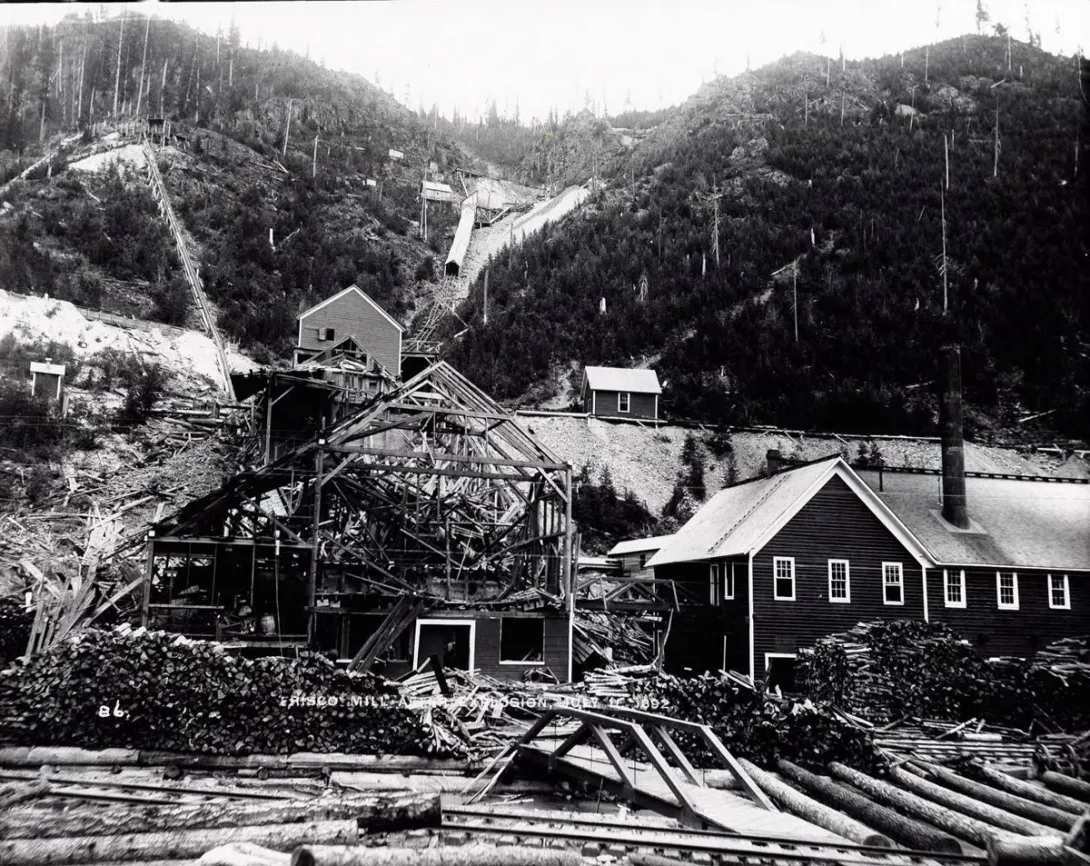
On the night of Sunday, July 10, 1892, the miners discovered who Siringo really was. The detective slipped out of the canyon ahead of the angry men searching for him, and by dawn hundreds of armed union miners had taken positions on the hillsides above the Frisco Mill, the big concentrating mill of the Gem mine in Burke Canyon, a few miles northeast of Wallace. Inside the mill, replacement workers and company guards refused to surrender.
The gun battle lasted for hours on the morning of July 11. Then the strikers sent a charge of dynamite down the mill's flume, the wooden chute that carried water down the hillside. The explosion tore the four-story mill apart. The men inside the wreckage surrendered and were marched away as prisoners of the union. When the fighting was over, five men were dead, and the Frisco Mill was a splintered skeleton, a ruin photographed by Wallace's own Barnard Studio and remembered ever since as the moment the strike turned into a war.
The owners' response came swiftly. Governor Norman B. Willey, himself a former mine manager, declared martial law in Shoshone County on July 12, and President Benjamin Harrison ordered federal troops to support the Idaho National Guard. Soldiers swept through the canyon camps and arrested nearly 600 union men, confining them in crude outdoor stockades the miners bitterly named "bullpens."
Martial law lasted about four months. In Wallace, the county seat and a stronghold of union sympathy, the strike's defeat was felt in every household. Yet the prosecutions collapsed: in the end, none of the charges brought against the union men were upheld. The miners walked free, and the owners had won the valley at the cost of making enemies for a generation.
The crackdown also backfired in a way the owners never intended. Men who had shared the bullpens carried the lesson across the West, and in 1893 union miners founded the Western Federation of Miners, with Coeur d'Alene strike leader Ed Boyce later serving as its president. The federation became one of the most militant labor organizations in American history. Violence returned to the district in 1899, when union men dynamited the Bunker Hill mill at Wardner and martial law came to Shoshone County a second time.
Today, Burke Canyon is quiet, its mines and mills mostly gone. But the summer of 1892 still shapes how the Silver Valley remembers itself: a place where the wealth underground was matched by the determination of the men who dug it, and where Wallace learned early that its history would never be dull.
Photograph: The Frisco Mill after the explosion of July 11, 1892, photographed by Barnard Studio of Wallace. Barnard-Stockbridge Photograph Collection, University of Idaho Library. Public domain.