For roughly a century, the world's oldest profession operated in Wallace in plain sight. In most American towns, the trade hid in shadows and euphemisms. In this Idaho silver camp, it was an open secret: confined to a known district, watched over by the city health officer, and run by madams whom much of the town regarded as respectable businesswomen. Wallace remembers the era today with more candor than embarrassment.
The conditions that created it were plain arithmetic. When Wallace was founded in 1884, men pouring into the Coeur d'Alene mines outnumbered women by as much as two hundred to one. Saloons, gambling halls, and parlor houses followed the payrolls. In the 1890s, Madam Effie Rogan ran a house called the Reliance on Pine Street, and Gracie Edwards opened The Star, an upscale parlor house that advertised its grand opening in the local papers. After President Theodore Roosevelt visited Wallace in 1903, the city moved the working women into a designated restricted district on the triangle of land north of Cedar Street, and in 1904 Mayor Rossi ordered them confined to Avenue A, the alley running through it.
What grew there was less a den of vice than a regulated industry. In 1913, money from the district financed local improvements, and the red-light district became the first part of Wallace to receive paved streets. In 1917 the city council placed the district under the oversight of the health officer, the beginning of a medical regime in which the women received regular examinations by doctors. The rules were understood: the women did not solicit on the streets, the houses kept to their second-floor quarters, and in return the town left them alone. Local photographer Nellie Stockbridge photographed the women for licensing and record-keeping from the 1940s into the 1960s, and her portraits survive today in the Barnard-Stockbridge Collection at the University of Idaho Library.
The madams, for their part, gave generously. They donated to charities, quietly helped families in hard times, and earned a reputation for civic-mindedness that locals still repeat. Wallace poet Linda Beeman captured the arrangement in verse: every twelve-year-old selling something for a fundraiser knew, like the Lord's Prayer, that the first step to climb led to a brothel door.
By the middle of the twentieth century, five established houses operated on the second floors of downtown buildings: the Lux, run for some thirty years by the widely respected Dolores Arnold, who added the Luxette in 1967; the Arment; the U&I Rooms; the Sahara; and the Oasis, upstairs at 605 Cedar Street. Ginger Murphy arrived in 1963 and ran the Oasis for twenty-five years as a famously tight ship, employing five to eight women, insisting on regular health testing, and splitting earnings sixty-forty in the women's favor.
The end came in stages. A 1972 change in Idaho law made prostitution illegal statewide and stripped small towns of their authority to regulate it, and in 1973 Wallace's five houses closed "permanently" — for about a week. They reopened quietly, their signs taken down for good. The true end arrived in January 1988, when word reached Ginger Murphy that the FBI was coming. She and her women walked out of the Oasis leaving nearly everything behind — clothing, toiletries, groceries still in the bag — expecting to return within days. Instead, the federal investigation widened, the county sheriff was later charged with protecting the houses, and the Oasis never reopened. The last traces of the trade faded from Wallace by the early 1990s.
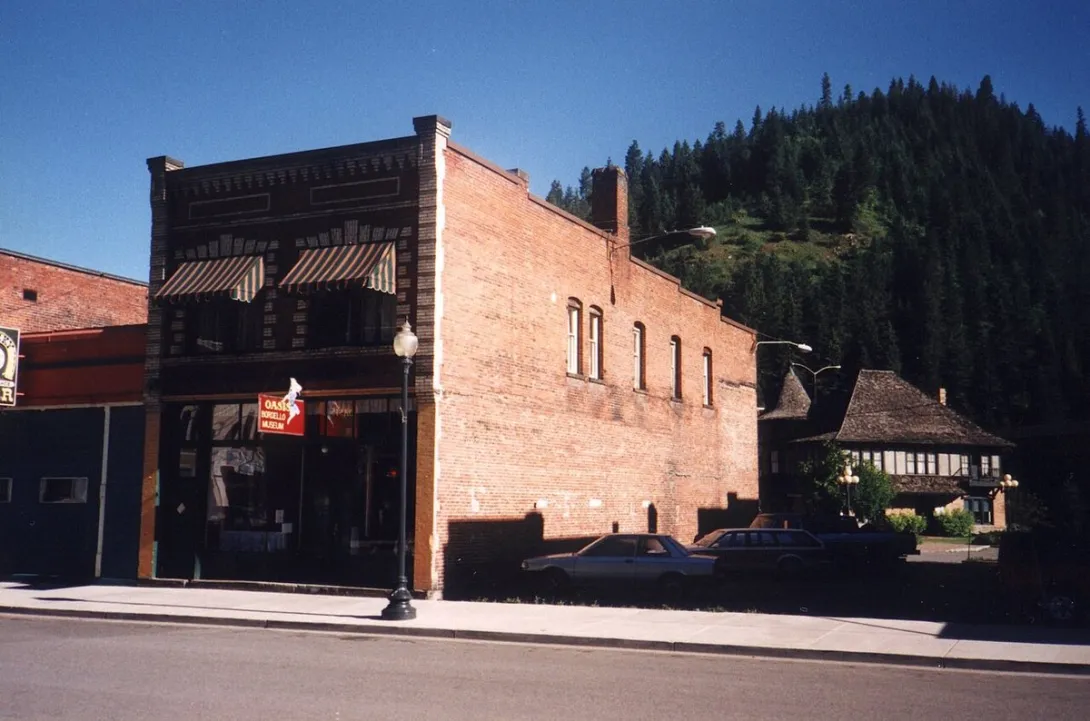
In 1993 the Oasis building was sold, and its new owners found the upstairs rooms almost exactly as they had been abandoned five years earlier. They opened the Oasis Bordello Museum, which still offers guided tours at 605 Cedar Street in the summer season, its rooms preserved as a time capsule of the era. Historian Heather Branstetter, herself a Wallace councilwoman, told the full story in her 2017 book Selling Sex in the Silver Valley. Wallace's open secret is now simply part of its history, preserved like everything else in this town.
Photo: The Oasis Bordello Museum building on Cedar Street in Wallace. Photo by Blake Handley, CC BY 2.0, via Wikimedia Commons.