Seven miles northeast of Wallace, a narrow cut in the Coeur d'Alene Mountains tells one of the Silver Valley's most remarkable stories. Burke Canyon, followed by Canyon Creek, became a string of mining camps after rich silver and lead were discovered there in 1884. The first mine at Burke, the Tiger Mine, was discovered in May 1884, and the town of Burke itself was established in 1887. Within a few short years, mines and mills crowded the hillsides, miners poured in, and a true boomtown grew in a place that seemed to have almost no room for one.
Click to see more photos of Burke and the Hercules Mine — historic photographs from the Barnard-Stockbridge Photograph Collection
Did you know Burke Canyon is only about 300 feet wide? Burke had to share that tight space with Canyon Creek, a road, and the railroad, so the tracks ran right through the center of town and served as its main street. On July 6, 1887, S. S. Glidden incorporated the Canyon Creek Railroad, a three-foot narrow-gauge line that ran from Wallace to the Tiger Mine. Shopkeepers reportedly retracted their awnings so trains could pass. The town's most famous answer to the squeeze was the 150-room Tiger Hotel, which straddled Canyon Creek and was built so that the railroad and the road ran through its lobby. Guests could step off the train and into the hotel, because there was simply nowhere else for either one to go.
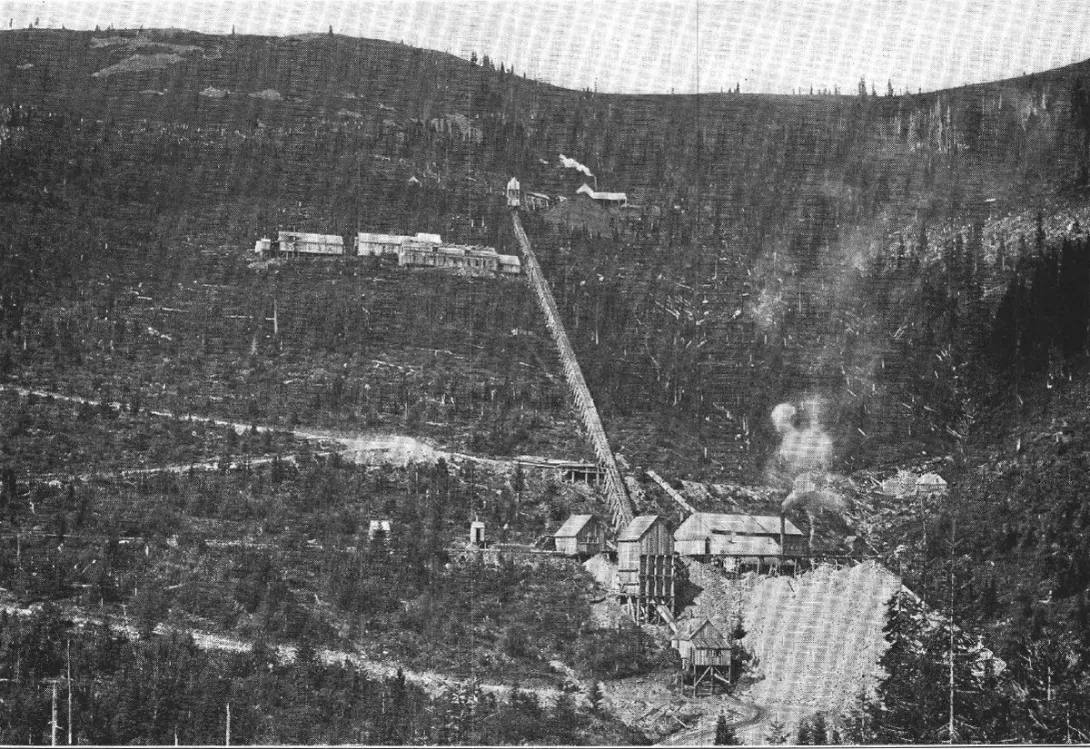
Above the town, the Hercules Mine waited more than a decade to make its discoverers rich. In August 1889, Harry L. Day, a bookkeeper and clerk, and Fred Harper, a local prospector, walked about a mile and a half up the pack trail between Burke and Murray and staked the Hercules and Firefly claims. A dozen years of development brought no production, and then, on June 2, 1901, a rich silver-lead vein was struck in the No. 2 Tunnel. The first commercial shipments went out that fall, the partners received their first dividend in December, and by the end of 1903 the Hercules was netting 40,000 dollars a month. Its first mill opened in Burke in late 1905, it was the most profitable mine in the district in 1916, and its dividends peaked at 3,800,000 dollars in 1917.
Burke's other great mines shared the canyon. The Hecla Mine was discovered by James Toner on May 5, 1885, and the Hecla and Star mines also operated out of Burke alongside the Tiger-Poorman and the Hercules. At its peak, Burke was home to 1,400 people in 1910. Life in the narrow canyon was never easy, though. An avalanche on February 4, 1890, caused major damage and killed three people, and a fire on July 13, 1923, destroyed much of the town. Each time, Burke rebuilt and the mines kept working.
That long run finally ended when the last mine in Burke, the Star, closed in 1991, and Burke became a ghost town. Today the canyon is quiet, but it has not been erased. The massive buildings of the Hecla Mining Company still tower over the road, the Hercules workings still mark the hillside above town, and a drive up Idaho State Highway 4 from Wallace still passes the camps that once lined Canyon Creek. Burke remains the Silver Valley's clearest reminder that a town did not need width to have a very large history.
Photo: The Hercules Mine in Burke in 1904. Photograph by Nellie Stockbridge, Barnard-Stockbridge Photograph Collection, University of Idaho Library. Material has likely passed into the public domain.