Edward Crockett Pulaski was not a young man when he joined the fledgling U.S. Forest Service in 1908. Born in 1866, he had spent years in the West as a miner, a railroad worker, and a ranch foreman before pinning on a ranger's badge in the Coeur d'Alene National Forest, based at Wallace. "Big Ed," as the men called him, knew the ridges and canyons of the Silver Valley as few others did. In August 1910, that knowledge saved dozens of lives — including, barely, his own.
On August 20, 1910, Pulaski was supervising fire crews along the West Fork of Placer Creek, a few miles south of Wallace, when the Great Fire of 1910 blew up. Hurricane-force winds turned hundreds of scattered fires into a wall of flame. Pulaski gathered about 45 men — his own crew and stragglers separated from other outfits — and told them their only chance was to run for Wallace. Partway down the canyon they met flames coming up toward them. Pulaski turned toward the War Eagle Mine, found that route cut off as well, and reversed course uphill to a place he knew: the abandoned Nicholson Mine, a short prospector's tunnel driven into the hillside.
All but one of the men reached the tunnel; the two horses with the party died outside. Inside the cramped adit, some 80 feet long and barely tall enough to stand in, Pulaski ordered his men to lie face down on the floor to escape the smoke and gas. As the firestorm roared over the canyon, some of the men panicked and tried to run back out into certain death. Pulaski drew his pistol and told them the first man who tried to leave would be shot. When the timbers at the tunnel mouth caught fire, he beat back the flames with horse blankets and carried water from a trickle on the mine floor in his hat, scorching his hands and face.
By morning the fire had passed. Five men had died in the tunnel, and with the man lost on the trail, six of the party were gone — but 39 firefighters walked out alive and made their way down to Wallace. Pulaski himself spent nearly two months in the hospital, suffering from burns, pneumonia, and temporary blindness, and he carried scars on his hands and face for the rest of his life. He never cared for the word "hero," and he did not commit his own account of that night to paper until 13 years later.
Pulaski's second legacy rides in the hands of nearly every wildland firefighter working today. In 1911 he refined a combination tool of his own design: an axe on one side of the head and a mattock, a digging blade, on the other, so that a single tool could both chop and dig fire line. The "Pulaski" became standard Forest Service equipment, and firefighters still swing it on fire lines across the country. A prototype initialed "E.P." is preserved at the Wallace District Mining Museum, in the collection of the Smithsonian Institution.
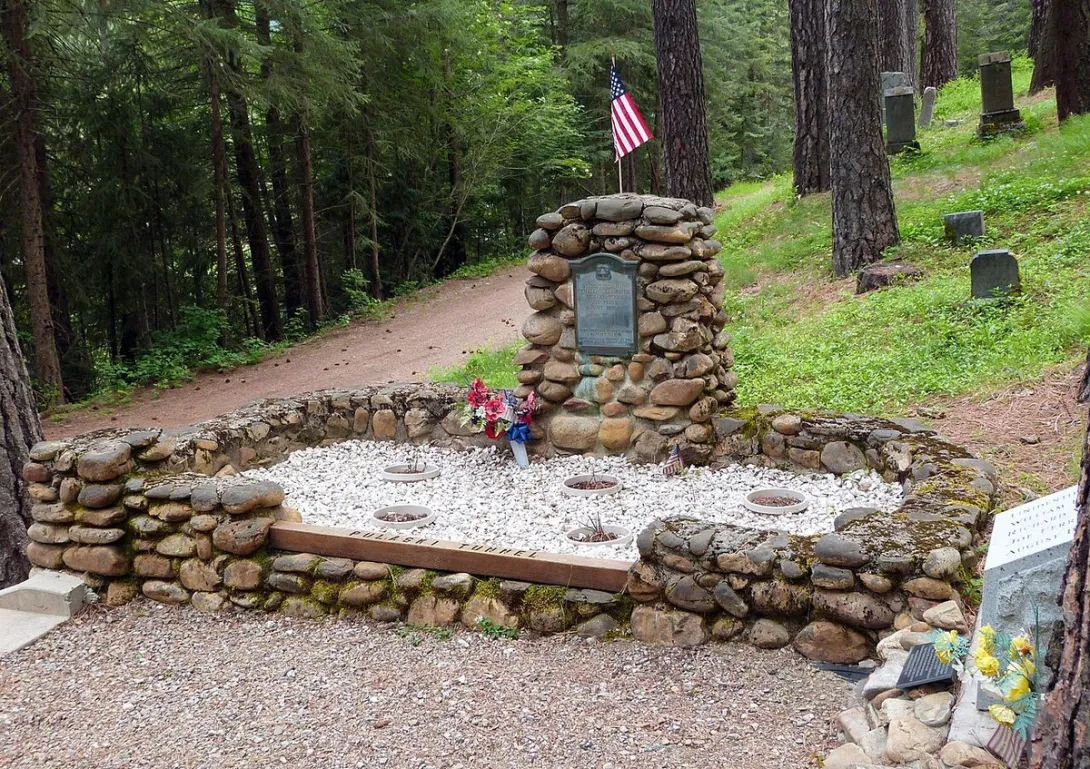
The Nicholson adit is known today as the Pulaski Tunnel, and it is listed on the National Register of Historic Places. The Forest Service's Pulaski Tunnel Trail follows the crew's escape route up the West Fork of Placer Creek to an overlook facing the tunnel mouth, about two miles from the trailhead near Wallace. At Nine Mile Cemetery in Wallace, where five of the men who died that night are buried, a stone memorial honors Pulaski and his crew — a quiet place to remember the ranger who held a gun on his own men, and saved nearly all of them.
Photo: the Pulaski Tunnel memorial at Nine Mile Cemetery in Wallace. Photograph by Ian Poellet, CC BY-SA 4.0, via Wikimedia Commons.