Did you know that one of Idaho's greatest mining towns owes its name, and its start, to a stray jackass? In September 1885, prospector Noah S. Kellogg was camped along Milo Creek, in the South Fork of the Coeur d'Alene River, when, as the story has long been told, his jackass wandered off and led him to a shining outcrop of galena, the lead and silver ore that would change the Silver Valley forever. The paperwork tells the plainer version of the same moment. Philip O'Rourke filed the Bunker Hill mining claim on September 10, 1885, along the west side of Milo Creek, listing a discovery date of September 4 with Noah Kellogg as a witness. The claim was named for the Revolutionary War battle of Bunker Hill, and companion claims, including Cornelius Sullivan's Sullivan claim on the east side of the creek, soon followed.
Click to see more photos of the Bunker Hill Mine — historic views of the mine and mill in Kellogg and Wardner
That outcrop, later worked as an open cut remembered as the Glory Hole, became the Bunker Hill and Sullivan mines. Simeon Reed bought the mine and mill and incorporated the Bunker Hill and Sullivan Mining and Concentrating Company on July 29, 1887. What began with wagons hauling milled ore to steamboats grew into an industrial giant. The Old South Mill began operating in 1891, a 10,000-foot aerial tramway linked the workings at Wardner with the mill at Kellogg, and the more than 12,000-foot Kellogg Tunnel, completed in the early 1900s, tied the underground mine directly to Kellogg. A lead smelter at Smelterville began operating on July 5, 1917, and the property eventually grew to some 620 claims covering about 6,200 acres.
Kellogg grew up in the mine's shadow, and for generations the company and the town were nearly one and the same. The settlement first known as Milo took Kellogg's name, and Bunker Hill, affectionately called Uncle Bunker by many residents, was for years among Idaho's largest employers. In all, from 1885 to 1981, the Bunker Hill produced more than 35 million tons of ore, yielding lead, zinc, silver, cadmium, and a long list of other metals. The company also shaped daily life off the job, building community facilities that included a YMCA in Kellogg with a swimming pool, a bowling alley, and a basketball court, an investment meant to turn a mining camp into a hometown.
The end came suddenly. Gulf Resources and Chemical Corporation, which had acquired Bunker Hill in 1968, announced the closure in 1981, citing low metal prices and stricter federal lead standards, and the mine and smelter complex closed in 1982. At that moment the Bunker Hill lead smelter was the largest in the world, and more than 2,000 people lost their jobs. In 1983 the United States Environmental Protection Agency placed the site on the National Priorities List as a Superfund site. On May 27, 1996, the four great smelter smokestacks that had defined Kellogg's skyline, the tallest of them 715 feet, were toppled with explosives.
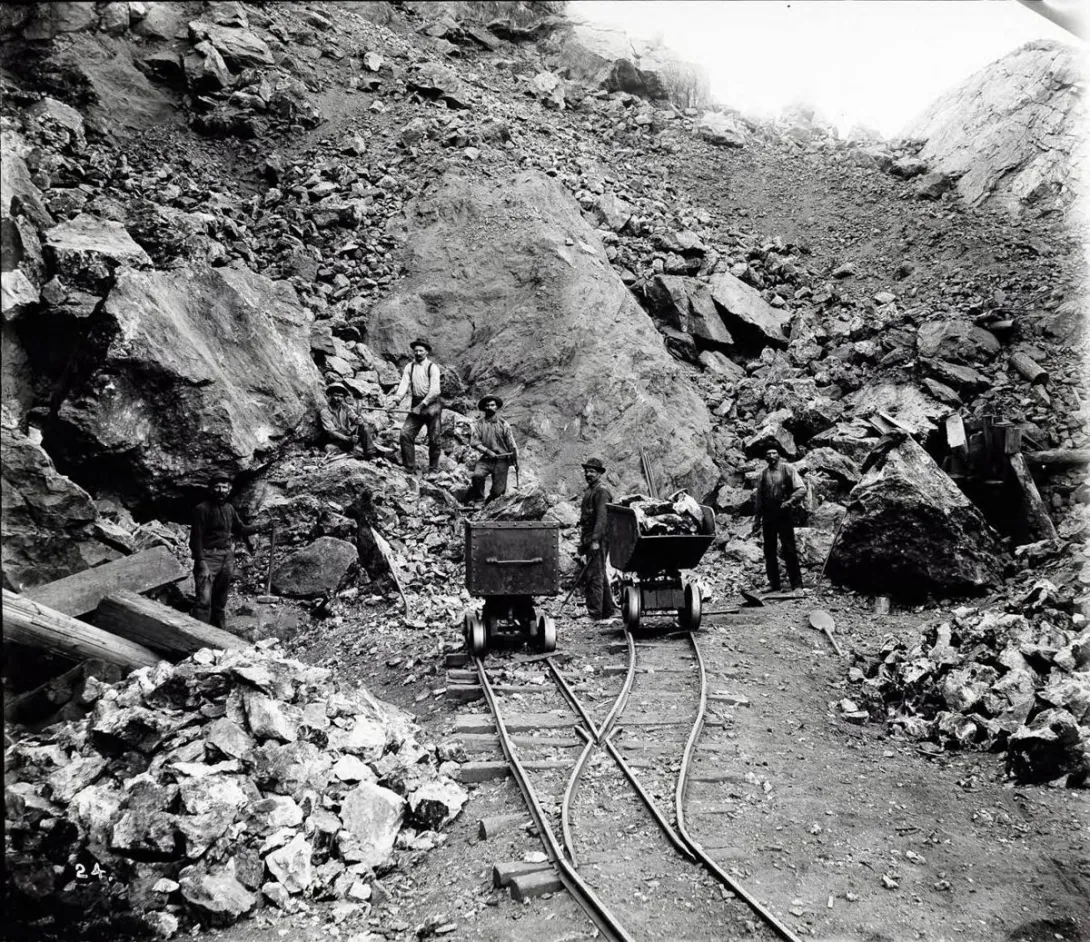
Today Kellogg welcomes skiers and visitors headed for Silver Mountain, but its streets still run on a foundation laid in 1885. The jackass may get the credit in the legend, but it was the men in photographs like the one above, standing with their ore cars at the Glory Hole, who turned a lucky discovery into a town and a century of Silver Valley history.
Photo: Miners and ore cars at the Bunker Hill Glory Hole, the original Bunker Hill outcrop near Kellogg. Barnard Studio, Barnard-Stockbridge Photograph Collection, courtesy of the University of Idaho Library. Material has likely passed into public domain.