Wallace and Kellogg often take the spotlight in the Silver Valley, but the valley was built just as much by its smaller towns. Osburn, Pinehurst, and Silverton grew up between the big mines along the South Fork of the Coeur d'Alene River, and each carries part of the story.
Osburn began at a crossroads. In March 1886, Stephen V. Osburn, known as Bill Osburn, bought 160 acres where the Mullan Road met the Two Mile Road and built a roadhouse there. The settlement was first called Georgetown, after local miners W. P. and Lee George, before taking Osburn's name, and the post office adopted the Osburn spelling in 1887. Just west of town, Weldon B. Heyburn, who later became a United States senator from Idaho, had staked the Polaris claim on August 30, 1884, one of the first claims along the South Fork. Osburn served as the seat of Shoshone County from 1890 to 1893, when the seat moved to Wallace, and the great Osburn Fault, the geological structure that runs through the district's richest silver belts, still bears the town's name.
Pinehurst, at the western end of the Silver Valley, grew more slowly. The town sits just south of where Pine Creek joins the South Fork of the Coeur d'Alene River, in country first worked by loggers, miners, and trappers in the Pine Creek drainage south of town. The Douglas Mine up Pine Creek, where ore was first discovered in 1898, survived fires in 1924 and 1928 and worked on and off until 1972. Pinehurst itself is one of the younger towns in the valley, and it was incorporated in 1970. Its streets are named for states, so a short walk can take you from Ohio toward Wyoming and beyond, and the 2020 census counted 1,679 residents in this quiet end of the valley.
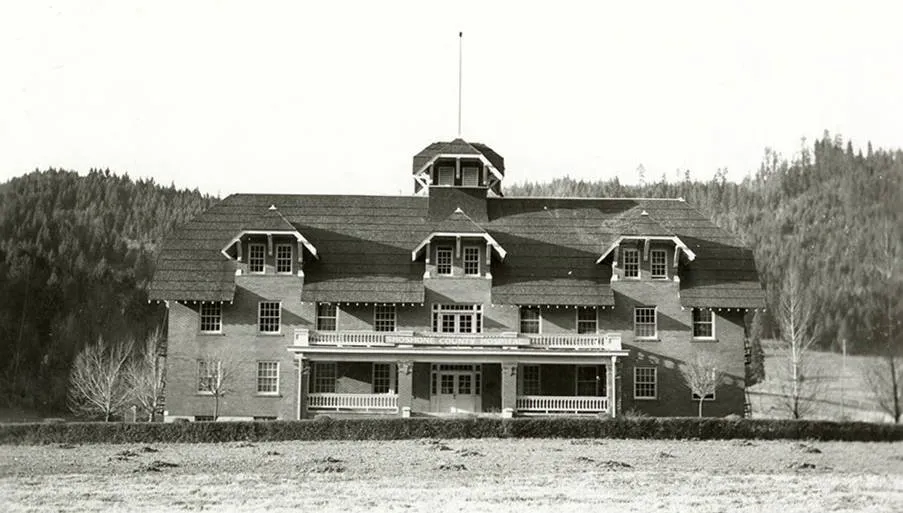
Silverton, just west of Wallace, started with a very different name. Around the turn of the twentieth century it was known as Stump Town, a quiet farming area in a sunny open bowl against the Bitterroots, about two miles from Wallace. In 1916 the Strope family sold its homestead to Shoshone County for a poor farm, and the farm was built the following year with bricks from a local brickyard. That poor farm later became the county infirmary and then the county nursing home, and its buildings were eventually reused as Forest Service offices. In 1947 a post office was created in the local store, and with it the community took the name Silverton, a name suggested by a neighbor who had come from Colorado.
Mining was never far away in Silverton. Up Lake Gulch, about a mile south of town, the Galena Mine had its beginnings in claims located in the 1880s, with serious mining beginning in 1917. After the mine sat idle from 1931, ASARCO and its partners developed it between 1947 and 1954, and it went into production in 1955. The Galena has since produced more than 240 million ounces of silver, along with lead, copper, and antimony, and it still employs miners today. Behind the old poor farm, radio station KWAL, the Silver Valley's only radio station, also signed on in 1938 before moving to Osburn in 1948. Together, these three towns remind us that the Silver Valley's heritage lives not only in its famous mines, but in its roadhouses, farms, and neighborhoods as well.
Photo: Shoshone County Hospital in Silverton, Idaho, about 1917, by Barnard Studio. Barnard-Stockbridge Photograph Collection, University of Idaho Library. Material has likely passed into the public domain.