Fifteen miles east of Wallace, a gravel trail slips into a tunnel nearly two miles long, crosses steel trestles high above mountain creeks, and descends a canyon wall through the Bitterroot Mountains. The Route of the Hiawatha rail-trail follows the most expensive and difficult stretch of railroad ever built in the Northwest — the Milwaukee Road's crossing of St. Paul Pass — and every mile of it is steeped in the history of the men who built it.
In 1905, the Chicago, Milwaukee and St. Paul Railway — the Milwaukee Road — decided to extend its lines all the way to the Pacific coast. Surveyors spent months exploring some 930 miles of possible crossings through the Bitterroots before settling on St. Paul Pass, on the Idaho-Montana line. Construction of the Pacific Extension ran from 1906 to 1911, employed thousands of workers drawn from more than a dozen nations, and cost a record 260 million dollars. One old-timer quoted by the U.S. Forest Service called the result "the best darn railroad in the world."
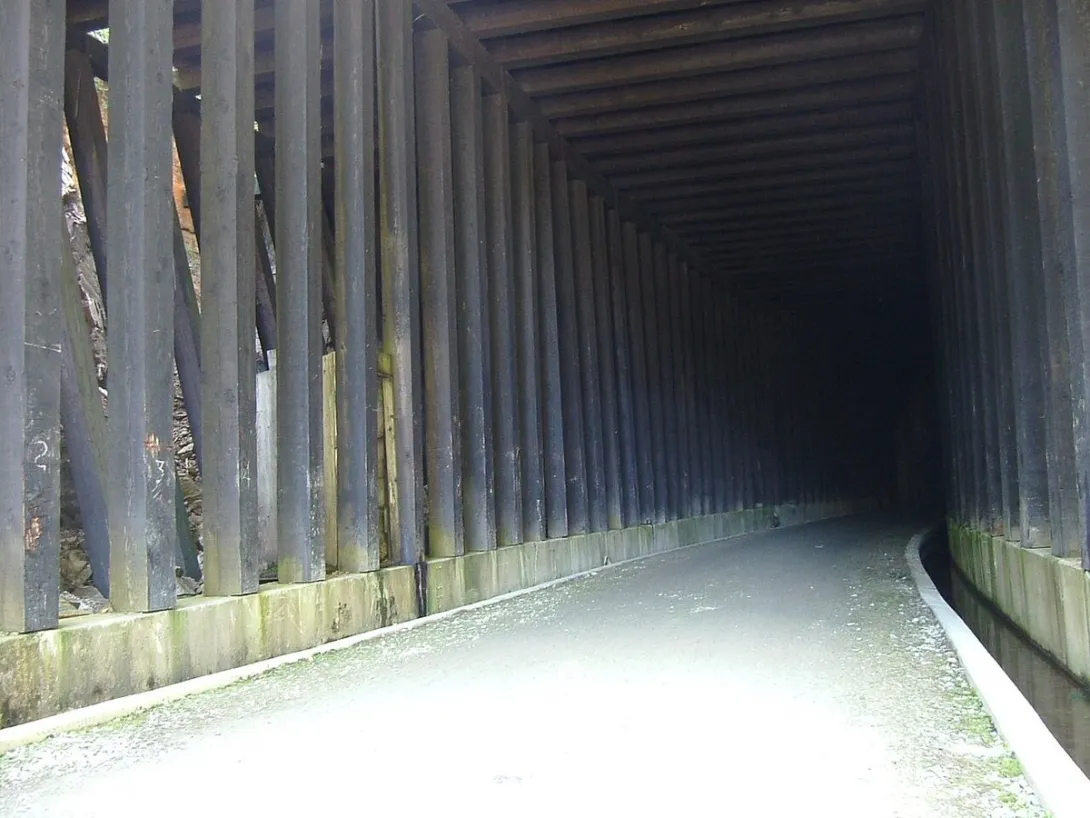
The centerpiece of the crossing is the St. Paul Pass Tunnel, better known to riders today as the Taft Tunnel. Heavy boring began in 1907, and the 8,771-foot bore — 1.66 miles, with its east portal in Montana and its west portal in Idaho — was finished in December 1908, a thousand feet below the summit above it. The tunnel holds a steady 47 degrees year-round. At its east end grew the rowdy construction camp of Taft, Montana, which took its name from Secretary of War William Howard Taft after a famous visit. From the tunnel, the line descended Loop Creek canyon on a steady 1.7 percent grade, carried across side canyons on high steel trestles. In time the Milwaukee Road electrified its mountain divisions, creating what was then the longest electrified mainline railroad in the world.
The railroad was barely finished when the mountains tested it. In August 1910, the Great Fire — the Big Burn — swept the Bitterroots in a firestorm that consumed whole towns. Taft burned. Milwaukee Road crews ran trains through the flames to the safety of Avery, Idaho, picking up hundreds of refugees from the burning settlements along the line, in one of the most celebrated rescues of the fire.
For half a century, freight and passengers crossed the pass in style. The railroad's flagship streamliner, the Olympian Hiawatha, carried travelers between Chicago and the Puget Sound country through the tunnel and over the trestles, its distinctive observation cars giving passengers a front-row view of the canyon. But highways and hard times caught up with the Milwaukee Road. Passenger service over the line ended in 1961, the railroad fell into its final bankruptcy in 1977, and the last train crossed St. Paul Pass in 1980 before the Pacific Extension was abandoned.
The story did not end there. The U.S. Forest Service transformed the old grade into the Route of the Hiawatha, which opened to riders on May 29, 1998. The Taft Tunnel itself reopened at the end of May 2001, completing the 15-mile route through 10 tunnels and over 7 high trestles from the East Portal down to Pearson, on the North Fork of the St. Joe River. Today the trail is operated by Lookout Pass Ski and Recreation Area under a Forest Service permit, and in 2010 the Rails-to-Trails Conservancy inducted it into its Rail-Trail Hall of Fame. Cyclists still ride the alignment the surveyors chose in 1905 — through the tunnel the Taft crews bored, across the trestles the steel gangs raised, and down the canyon the Olympian Hiawatha once descended with the lights on.
Photo: Inside the timber-lined Taft Tunnel on the Route of the Hiawatha. Photograph by Robert Ashworth, via Wikimedia Commons, licensed CC BY 2.0.