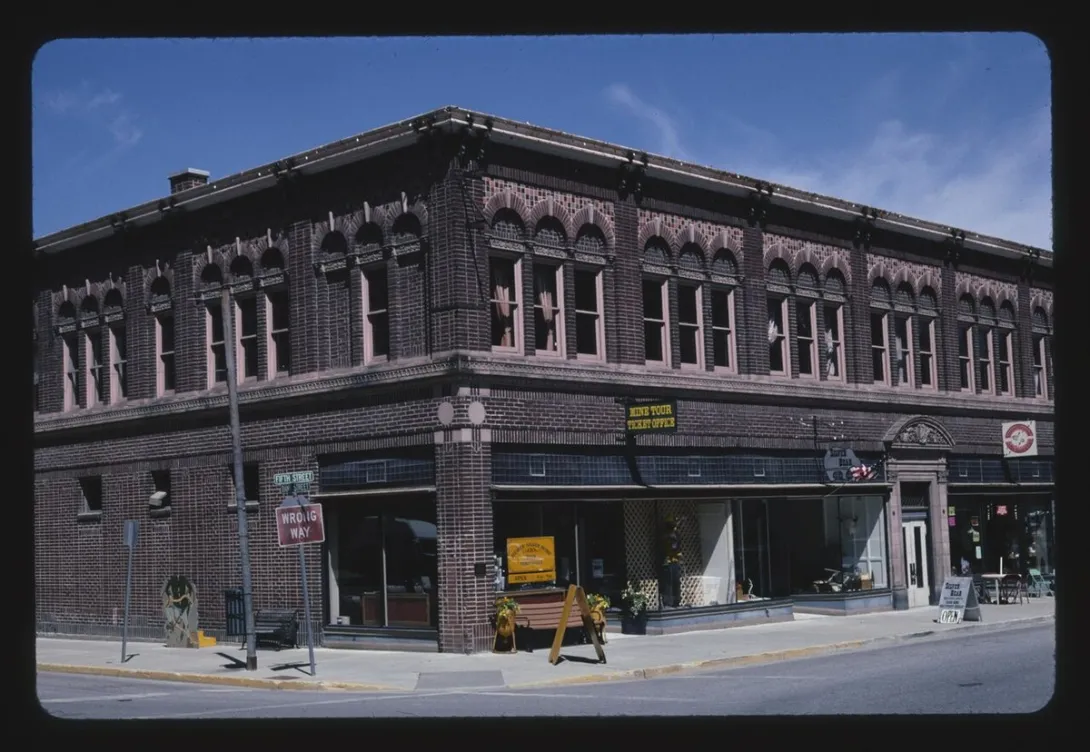
Drive into Wallace, Idaho, park on Bank Street, and look around. The brick bank buildings, the old hotels, the storefronts with their tall arched windows — nearly every building in sight is listed on the National Register of Historic Places. That is not an exaggeration. The Wallace Historic District covers essentially the entire town, which makes this Silver Valley mining town of a few hundred people one of the most thoroughly preserved communities in the American West.
Wallace was founded in 1884 and grew up as the commercial heart of the Coeur d'Alene mining district, one of the richest silver-producing regions on earth. As the seat of Shoshone County, it held the banks, the newspapers, the railroad depots, and the supply houses that served the great mines in the gulches around it. The wealth underground paid for substantial buildings above it, and Wallace built to last.
Fire shaped the downtown twice. In 1890, flames swept through the young town's wooden business district, and Wallace answered by rebuilding in brick and stone. Most of the commercial core that visitors admire today rose in 1890 and 1891, in the Romanesque Revival, Renaissance Revival, and late Victorian styles of the day. Twenty years later, the Great Fire of 1910 burned through the surrounding national forest and into the town's edges, but the brick business blocks stood. The district's official period of significance runs from 1890 to 1940, the half-century when nearly everything in town was built.
The National Register listing came in two steps. On August 10, 1979, the Wallace Historic District was entered in the National Register, covering 42 buildings in the downtown commercial core. Then, on September 1, 1983, a boundary increase enlarged the district to encompass the entire city limits of the time. The expansion added 13 individually listed or eligible buildings downtown and roughly 500 residences on the hillsides above the canyon floor — 301 contributing buildings in the increase alone. After 1983, to live in Wallace was, quite literally, to live in a historic district.
The timing was no accident. In the 1970s, highway planners drew the route of Interstate 90 straight through downtown Wallace, a path that would have demolished much of Bank Street. Town leaders fought back with the strongest tool available to them: federal historic preservation law. Listing the downtown on the National Register forced the highway's designers to reckon with what would be destroyed, and the fight ended in a compromise that became famous — the interstate would pass over Wallace instead of through it, carried on an elevated viaduct above the town.
Building that compromise took years. The 1901 Northern Pacific Depot, itself listed on the National Register in 1976, was picked up and moved a short distance to clear the way for construction. The elevated bypass finally opened in 1991, and downtown Wallace survived intact beneath it, one of the very few American towns that can say an interstate came to town and the historic center won.
The listing is still a living part of civic life. Wallace handles preservation through a combined planning, zoning, and historic preservation commission, and exterior work on buildings in the district goes through a Certificate of Appropriateness review. The result is visible on every block: original brickwork, period storefronts, and a main street that reads like an open-air museum of the silver era. In 2010, the American Planning Association named Bank Street one of its Great Streets in America. For visitors, the lesson is simple — in Wallace, the whole town is the attraction, and nearly every building in it has the paperwork to prove it.