Did you know that you can still walk into the Silver Valley's mining past, hard hat and all? Since 1884, the Coeur d'Alene Mining District has produced more than 1.2 billion ounces of silver, along with great quantities of lead and zinc, and most of that story unfolded in the narrow valley between Mullan and Kellogg. The big mines that built the valley have closed, but their story has not been lost. It is kept today by the valley's mining museums and by two remarkable preserved mines, one in Wallace and one near Kellogg, where visitors can still go underground and see how the work was done.
Click to see more photos of Wallace, Idaho — its historic streets, museums, and mining landmarks
The natural starting point is the Wallace District Mining Museum, at 509 Bank Street in the heart of Wallace. Founded in 1956 by Fred Levering, the museum tells the story of the whole Coeur d'Alene Mining District through more than 50 exhibits and an archive of more than 5,000 photographs and maps. Visitors can step into a recreated mine, study a large three-dimensional model of the Sunshine Mine, and watch a documentary film in the museum's theater. In 2013, the museum received the Sister Alfreda Elsensohn Award from the Idaho Humanities Council and the Idaho State Historical Society, honoring its service and leadership among Idaho museums.
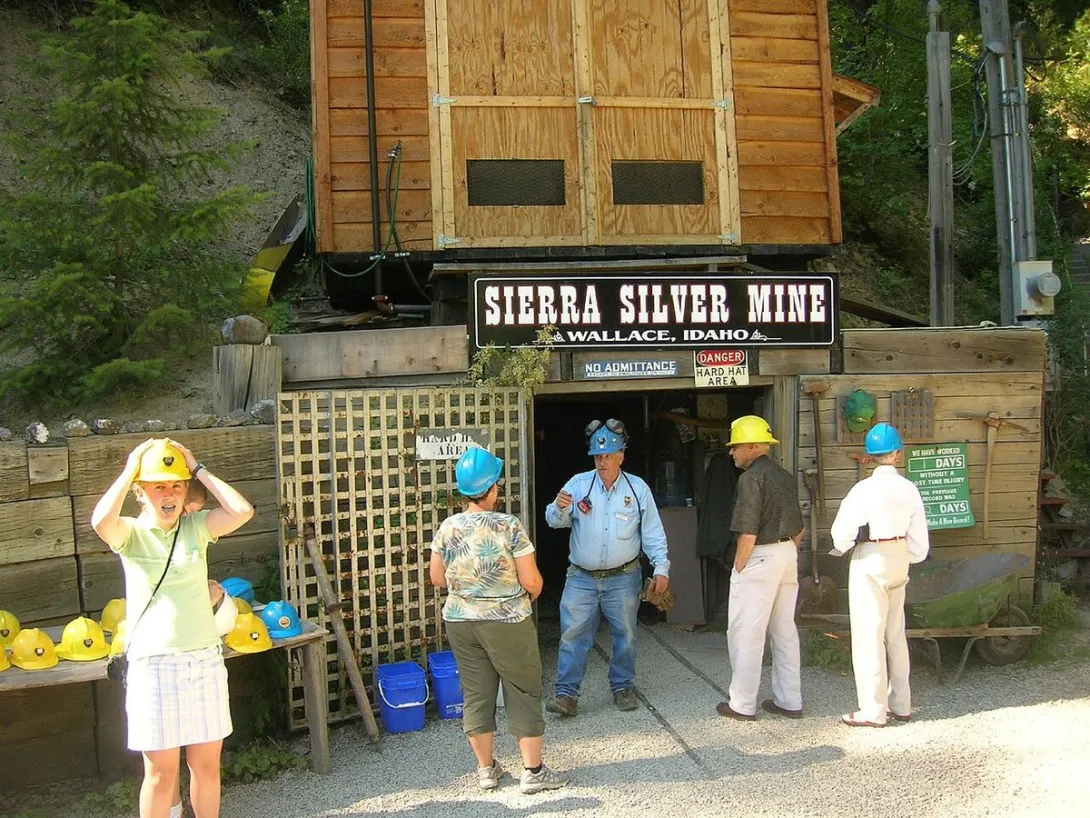
For the real thing, the Sierra Silver Mine Tour begins a few blocks away in downtown Wallace. The Sierra Mine was discovered around 1900, but its ore never proved rich, running only about half an ounce of silver to the ton, and the mine changed hands several times without ever supporting steady production. A more thorough exploration in the 1960s sank an incline shaft and drove several hundred feet of tunnel, and the mine later served as a working laboratory where local high school students learned mining skills. In 1982, local businesspeople formed the nonprofit Sierra Silver Mine Tour, Inc., and turned the old mine into a living classroom. Today a narrated trolley carries visitors from Wallace up to the portal, where experienced guides, many of them retired miners, lead the walk underground and demonstrate hard-rock mining methods with real equipment in season, from May through October.
West of Wallace, near Kellogg, the Crystal Gold Mine offers a different treasure. One of the first hard-rock mines in the Silver Valley, it was worked in the 1880s and then concealed, its entrance hidden, with tools, a mine car, and tracks left inside. The mine stayed hidden for more than a century, until the landowner noticed water seeping from the hillside in 1991 and rediscovered the portal. The property was reclaimed in 1996 and opened to the public as a tour mine in 1998. Visitors now walk about 900 feet into the mountain on well-lit walkways, see the colorful smithsonite crystals that give the mine its name, watch hand-steeling demonstrations, and try gold panning, with entry to the Miner's Museum included.
Together, these places do something no book can do. The museum preserves the photographs, maps, and tools, while the Sierra Silver and Crystal Gold mines preserve the feel of the work itself, the cool air, the hard rock, and the skill it took to bring silver and gold out of these mountains. They are proof that the Silver Valley's greatest lode may now be its memory, carefully kept for everyone who comes to learn it.
Photo credit: Justin Brockie, via Wikimedia Commons, licensed under CC BY 2.0.