Skip to header Skip to main navigation Skip to main content Skip to footer
Home
Wallace Idaho
History Written in Silver

Main navigation

  • Home
  • Dining
  • Lodging
  • Shopping
  • Skiing
  • Things to Do
  • Outdoors
  • History
  • Business Directory

Idaho History

The Northern Pacific Depot: Wallace's Railroad Landmark
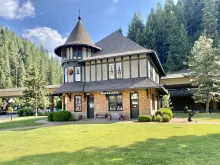
The chateau-style Northern Pacific Depot in Wallace, Idaho, with its conical turret and the Interstate 90 viaduct behind it.

Of all the buildings in Wallace, the one travelers remember best may be the one built for travelers. The Northern Pacific Depot, with its brick first story, its stuccoed second story, and its storybook turret, has stood at the north end of Sixth Street since the first years of the twentieth century, and for most of that time, it was Wallace's front door.
  • Read more about The Northern Pacific Depot: Wallace's Railroad Landmark

The Last Stoplight on Interstate 90: How Wallace Stood Its Ground

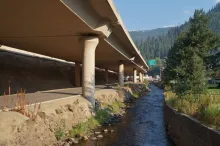
The elevated Interstate 90 viaduct carries traffic above the South Fork of the Coeur d'Alene River at Wallace, Idaho.

Every coast-to-coast drive in America once ended the same way: at a red light in downtown Wallace. Interstate 90 runs more than 3,000 miles from Seattle to Boston, and for years the entire route was a modern, limited-access freeway, except for a few blocks in this little silver town in the Idaho Panhandle, where the interstate simply stopped, funneled every car and truck down Wallace's streets, and made them all wait at a single traffic signal.

  • Read more about The Last Stoplight on Interstate 90: How Wallace Stood Its Ground

The 1892 Miners' Strike and the Frisco Mill Explosion

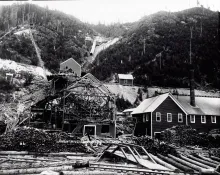
The wrecked Frisco Mill in Burke Canyon after the dynamite explosion of July 11, 1892, photographed by Barnard Studio of Wallace.

Eight years after Wallace was founded in 1884, the young silver town found itself at the center of one of the most violent labor struggles in American history. The Coeur d'Alene mining district, a chain of camps strung through the narrow canyons around Wallace, was booming on lead and silver, but in early 1892 the mine owners announced districtwide wage cuts, effective April 1. The miners' unions answered with a strike, and the Silver Valley settled into an armed standoff that would end with a mill in ruins, hundreds of men in open-air prisons, and soldiers patrolling Shoshone County.

  • Read more about The 1892 Miners' Strike and the Frisco Mill Explosion

The Route of the Hiawatha: A Railroad Through the Bitterroots

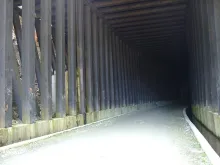
The timber-lined interior of the Taft Tunnel along the Route of the Hiawatha rail-trail.

Fifteen miles east of Wallace, a gravel trail slips into a tunnel nearly two miles long, crosses steel trestles high above mountain creeks, and descends a canyon wall through the Bitterroot Mountains. The Route of the Hiawatha rail-trail follows the most expensive and difficult stretch of railroad ever built in the Northwest — the Milwaukee Road's crossing of St. Paul Pass — and every mile of it is steeped in the history of the men who built it.

  • Read more about The Route of the Hiawatha: A Railroad Through the Bitterroots

The Sunshine Mine Disaster of 1972

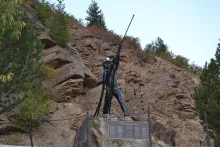
The Sunshine Miners Memorial statue of a miner raising his rock drill, standing on a rock base before a steep hillside at Big Creek, Idaho.

Every May 2, the Silver Valley stops to read 91 names aloud. They are the men who went underground at the Sunshine Mine on the morning of Tuesday, May 2, 1972, and never came home — victims of the worst disaster in Idaho history, and of an underground fire that changed American mining law forever.

  • Read more about The Sunshine Mine Disaster of 1972

A Town on the Register: Wallace's Historic Downtown

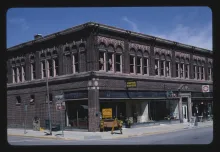
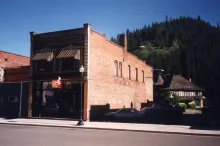
A historic dark-brick commercial building with arched windows on a downtown Wallace street corner.

Drive into Wallace, Idaho, park on Bank Street, and look around. The brick bank buildings, the old hotels, the storefronts with their tall arched windows — nearly every building in sight is listed on the National Register of Historic Places. That is not an exaggeration. The Wallace Historic District covers essentially the entire town, which makes this Silver Valley mining town of a few hundred people one of the most thoroughly preserved communities in the American West.

  • Read more about A Town on the Register: Wallace's Historic Downtown

Edward Pulaski: The Ranger, the Rescue, and the Tool That Bears His Name

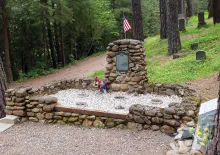
The stone Pulaski Tunnel memorial at Nine Mile Cemetery in Wallace, Idaho, honoring Ranger Edward Pulaski and the firefighters who died in 1910.

Edward Crockett Pulaski was not a young man when he joined the fledgling U.S. Forest Service in 1908. Born in 1866, he had spent years in the West as a miner, a railroad worker, and a ranch foreman before pinning on a ranger's badge in the Coeur d'Alene National Forest, based at Wallace. "Big Ed," as the men called him, knew the ridges and canyons of the Silver Valley as few others did. In August 1910, that knowledge saved dozens of lives — including, barely, his own.

  • Read more about Edward Pulaski: The Ranger, the Rescue, and the Tool That Bears His Name

Center of the Universe: Wallace's 2004 Proclamation

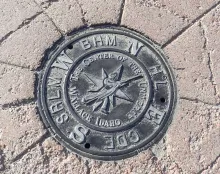
The cast-metal Center of the Universe marker set into the pavement at Bank Street and Sixth Street in Wallace, Idaho.

Stand at the corner of Bank Street and Sixth Street in downtown Wallace and look down. Set into the pavement is a handsome metal cover, cast like a manhole lid, bearing a compass rose, the figure of a miner, and a declaration no other town on earth can match: "The Center of the Universe — Wallace, Idaho." It is exactly what it claims to be, and Wallace has the paperwork to prove it.

  • Read more about Center of the Universe: Wallace's 2004 Proclamation

The Bordello Era: Wallace's Open Secret

The brick Oasis Bordello Museum building on Cedar Street in Wallace, once the town's best-known bordello.

For roughly a century, the world's oldest profession operated in Wallace in plain sight. In most American towns, the trade hid in shadows and euphemisms. In this Idaho silver camp, it was an open secret: confined to a known district, watched over by the city health officer, and run by madams whom much of the town regarded as respectable businesswomen. Wallace remembers the era today with more candor than embarrassment.

  • Read more about The Bordello Era: Wallace's Open Secret

The Great Fire of 1910: The Night Wallace Burned

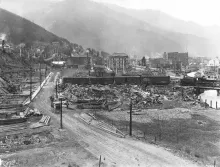
Wallace, Idaho in ruins after the Great Fire of 1910, with burned-out lots and railroad boxcars in the foreground and surviving brick buildings beyond.

The summer of 1910 was the driest in memory across the northern Rockies. By August, some 1,700 separate fires were burning in the national forests of northern Idaho and western Montana, fed by a record drought, logging slash, and sparks from locomotives. Forest Service crews — many of them hastily hired immigrants and students — fought the scattered fires for weeks with hand tools. Then, on Saturday, August 20, a violent cold front drove hurricane-force winds across the region, and in about 36 hours the separate fires merged into a single firestorm that burned roughly three million acres.

  • Read more about The Great Fire of 1910: The Night Wallace Burned

Pagination

  • Page 1
  • Next page ››
Subscribe to Idaho History

Wallace, ID Weather

Loading current conditions...

Loading forecast...

Upcoming Events

🎉 Wallace Events Calendar

Annual Favorites:
Statehood Day Parade — July 3
Huckleberry Festival and 5K Fun Run — August
Center of the Universe Re-Dedication — September
Fall for History — Early October
Home for the Holidays Christmas Festival — December

Coming Up:
Nov 26: Turkey Trot Fun Run and Walk — Thanksgiving Day, Downtown Wallace
December: Home for the Holidays Christmas Festival — Downtown Wallace

Article Archive

Browse past articles

Copyright © 2026 Rocky Mountain Madman LLC - All rights reserved

Developed and Designed by Rocky Mountain Madman LLC